2011/03/02

Letter to My Legislators (spelling corrected)

To: Senator Fukunaga
From: Malcolm Kirkpatrick
in re: Education and the State budget
2011-03-02 (2-Mar.-2011)

Aloha, Senator Fukunaga,

The State's amortized annual financial commitments (including pension and health care obligations to retired government workers and current employees) exceed its income. This condition defines "bankruptcy". In this respect, the government of Hawaii resembles many governments at all levels, city, county, and national, across the Earth. Politicians in democratic polities and bureaucrats in one-party States ascend the political hierarchy by promising support to superiors and buying support from constituents. Governments at all levels have made more promises than they can keep. When someone has made more promises than s/he can keep, s/he will break some.

The Governor and State legislators have arrived at only the first, just-walked-past-a-mirror-and-seen-themselves-naked stage of acceptance that the State needs to go on a financial diet. As with any serious addiction, government's addiction to tax revenues will not yield to the first, second, or probably even twentieth resolution to lose weight (or quit smoking, or quit drinking, or quit an abusive relationship).

The State of Hawaii cannot raise taxes. Literally "cannot". Charles Schultz, a Kennedy-Johnson era member of the President's council of economic advisers, called the Laffer curve a straightforeward consequence of standard economic analysis. Productive private-sector workers will not passively accept unlimited taxation. At some point, each productive private-sector worker (and corporation) will either 1) take productive work off the books, 2) trade productive work for leisure, or 3) move to a polity with a more favorable tax environment.

The government of Hawaii will cut spending. The only choices decision-makers have are when and where. The longer legislators procrastinate, the narrower and more unpleasant the range of options becomes. Legislators will not make up the State's budget shortfall seeking quarters under sofa cushions or making cuts to minor programs. Legislators will cut major programs or financial markets and a shrinking tax base will deprive them of any power to make these choices.

To minimize the harm of cuts, legislators must assess the relative value to taxpayers of individual State programs, and transfer to private service providers, whether under contract to the State or unsubsidized, those functions which State agencies currently perform which independent agents would fulfill better and cheaper. I suggest that the above considerations imply a major reduction in the DOE budget and in the State's role in the education industry.

Hawaii's government-operated K-12 schools cost taxpayers over $2.5 billion per year. It does not take 12 years at $16,000 per pupil-year to teach a normal child to read and compute. Most vocational training occurs more effectively on the job than in a classroom. Homeschooling parents out-perform classroom teachers. Independent and parochial schools outperform government-operated schools. In Hawaii, juvenile arrests fall when school is not in session. Juvenile hospitalizations for human-induced trauma fall when school is not in session.

In abstract the education industry, with its critical dependence on enormously varied inputs (each individual student's interests and abilities, each individual teacher's personality and skill) an its enormously varied outputs (the possible career paths which a modern economy offers) is an unlikely candidate for (inevitably bureaucratic) government operation. It is simple mental sloth and fear of organized insider interest groups that blocks a reconsideration of the arguments for the State role in the education industry.

There are too many "r"s in "revolution". Radical change imposes costs in the form of lost information. The least disruptive path from the current policy, which restricts individual parent's options for the use of the taxpayers' K-12 education subsidy to schools operated by government employees, is a policy I call "Parent Performance Contracting" (PPC).

1. Mandate that DOE schools --must-- hire parents, on personal service contracts, to provide for their children's education, if the parents apply for the contract.
2. A child is eligible if:
2.1 S/he is at or above age-level expectations on standardized tests of reading vocabulary, reading comprehension (any language) and math as of August 15, the start of the contract year, and
2.2 S/he has not been convicted of any felony or misdemeanor crime against persons or property in the previous calendar year.
3. Make payment equal to some fraction 1/2 < a/b < 1 of the previous year's Hawaii DOE regular-ed per pupil budget.
4. Make payment contingent on
4.1 Performance at or above age-level expectations on standardized tests of reading comprehension, reading vocabulary (any language) and Math and
4.2 Remaining conviction-free of crimes against persons or property.
5. Count students educated under this program as enrolled in the DOE school which they would otherwise attend.
6. Administer the GED at any age.
7. Allow children who test out of school before age 18 to apply the taxpayers' K-12 education subsidy toward post-secondary tuition or toward a wage subsidy at qualified (e.g., has filed W-2 forms on at least 3 adult employees per sub-adult employee for at least the previous four years) private-sector employer.

Parents could then homeschool, hire tutors, extend daycare to age 18, or supplement the contract amount and send their children to an independent or parochial school.

Parent Performance Contracting (PPC) has several advantages over school vouchers and charter schools.
1. Districts already hire consultants on personal service contracts, so PPC requires no new administrative machinery.
2. PPC includes all currently available options (e.g., homeschooling, charter schools, independent schools).
3. PPC provides greater financial and performance accountability than do school vouchers.
4. PPC requires less intrusive oversight than tuition tax credits.
5. PPC poses less of a threat to the autonomy of independent schools than do school vouchers.
6. PPC is less respectful of current institutions, and so will more likely promote more rapid evolution of the education industry than will school vouchers or charter schools.
7. Since children educated under PPC remain enrolled in State (government, generally) schools, PPC elides the whole Church/State separation argument.
8. Since children educated under PPC remain enrolled in State (government, generally) schools, PPC is immune to the rhetorical attack that it "takes money from public education" or "from public schools".
9. PPC allows incremental implementation, which reduces the financial shock to the current system, and which allows continual assessment and modification.
10. PPC reduces taxpayer exposure to uncertain (but substantial) future public-sector pension and health care costs.

cc Della Belatti

Updated: noun-verb agreement, add comma.

2011/02/09

EDN Hearings, 9, 11, Feb. (Wednesday, Friday)

Senate, Wednesday. What's up with SB 1104?
House, Wednesday. HB 941 (Homeschooling), HB 875 (Power of Atorney).
House, Friday (none).
Senate, Friday.

2011/02/08

Experience Abroad

The Cato Institute's Andrew Coulson points to a study of schools in Sweden since voucher implementation.
Summary
• For-profit schools benefit students from all socio-economic backgrounds, but they
produce the largest benefits for students from less privileged backgrounds.
• School competition in Sweden has increased levels of educational achievement.
• Free schools enjoy higher levels of parental satisfaction than government schools.
• Competition from free schools has improved conditions for teachers.
• The profit motive provides strong incentives for entrepreneurs to enter the schools market and to expand their businesses. Banning for-profit schools risks dramatically reducing the number of free schools that are created, thereby limiting the benefits of competition.

2011/02/07

SB 806

To: Members of the Senate Education Committee
From: Malcolm Kirkpatrick
in re: SB 806 (Teacher Standards Board)
2011-02-07

Please DO NOT support SB 806 as written.

The Hawaii DOE operates one of the largest school systems in the US, the only State-wide school district. According to the NCES 2009 Digest of Education Statistics, table 36 the DOE reported a 2006 fall enrollment of 180,729 students. Taxpayers supported the Hawaii DOE with a revenue stream of $2.985+ billion dollars in the 2006-2007 fiscal year, according to the US Census bureau's Public Education Finances, 2007, table 1. The DOE reported total current spending of $2.081+ billion, according to table 6 and per pupil spending (table 8) of $11,060. Table 11 puts the Hawaii per pupil revenue at $16,520, which ranks fifth in the US. For all this, the Hawaii DOE generates a level of performance which puts Hawaii in the national cellar, according to the National Assessment of Educational Progress (8th grade Math).

The above figures understate the cost of the Hawaii Department of Education. These figures do not include the cost of pension and health benefits to retired employees. These figures do not include the cost of pension and health benefit promises to current employees. These figures do not include the opportunity cost to students of the time that they spend in school. These figures do not include the cost to society of the lost information which a competitive market in education services would generate.

With SB 806, the legislature would tinker with an enterprise its defenders call "broken", "dysfunctional" and "obsolete". The Teacher Standards Board makes a large contribution to the failure of the State school system. Recall the history of this board. When Teacher Standards Board legislation first appeared before the Hawaii legislature, the HSTA testified in favor and the Board of Education opposed the legislation. At that time, I testified against the creation of a Teacher Standards Board. In the next session, the Board of Education supported the bill, and the legislature passed a bill that authorized the creation of a temporary board which was to prescribe credential requirements for applicants for teacher positions within the government school system. The Board would then hand these recommendation to the DOE Personnel Office and expire. Before the Teacher Standards Board existed, a Teacher Standards Board Planning Commission met to determine the shape of the Teacher Standards Board. This Planning commission discussed how to talk the legislature into making the Board permanent and how to talk the legislature into extending the Board's authority to teachers already in service. Since then, the legislature has repealed the sunset provision of the enabling legislation, expanded the Board from nine to fifteen members, and given the Board authority over licensing of teachers already in service. Meanwhile, the Board has failed to develop effective standards for new-hire or in-service teachers. For new-hire teachers, the Board requires College of Education training. No statistical, empirical evidence supports policies which restrict the teaching profession to graduates of Colleges of Education. For in-service teachers, the Board requires, among other things:
Standard V: Demonstrates Knowledge of Content
STANDARD STATEMENT V: The effective teacher consistently demonstrates competency in content area(s) to develop student knowledge and performance.
Performance Criteria for Standard V: The extent to which the teacher:
Keeps abreast of current developments in content area(s).
Teaches mastery of language, complex processes, concepts and principles unique to content area(s).
Utilizes the school's current technologies to facilitate learning in the content area(s).
Connects knowledge of content area(s) to students’ prior experiences, personal interests and real-life situations.
Possesses an understanding of technology appropriate to the content area, e.g. computer-assisted instruction.
and
Standard VI: Designs and Provides Meaningful Learning Experiences
STANDARD STATEMENT VI: The effective teacher consistently plans and implements, meaningful learning experiences for students.
Performance Criteria for Standard VI: The extent to which the teacher:
Plans and implements logical, sequenced instruction and continually adjusts plans based on learner needs.
Provides learning experiences and instructional materials that are developmentally appropriate and based on desired outcomes, principles of effective instruction and curricular goals.
Incorporates a variety of appropriate assessment strategies as an integral part of instructional planning.
Links concepts and key ideas to students’ prior experiences and understandings, using multiple representations, examples and explanations.
Applies concepts that help students relate learning to everyday life.
Provides integrated or interdisciplinary learning experiences that engage students in generating knowledge, using varied methods of inquiry, discussing diverse issues, dealing with ambiguity and incorporating differing viewpoints.
Teaches for mastery of complex processes, concepts and principles contained in the Hawaii Content and Performance Standards.
Provides knowledge and experiences that help students make life and career decisions.
Organizes material and equipment to create a media-rich environment.
and
Standard IX: Demonstrates Professionalism
STANDARD STATEMENT IX: The effective teacher continually evaluates the effects of his or her choices and actions and actively seeks opportunities to grow professionally.
Performance Criteria for Standard IX: The extent to which the teacher:
Engages in relevant opportunities to grow professionally, i.e., taking university/college or in-service coursework, actively participating in a professional organization, serving on a cadre, council, or committee or serving as a cooperating teacher, mentor or advisor.
Reflects on practices and monitors own teaching activities and strategies, making adjustments to meet learner needs.
Provides and accepts evaluative feedback in a professional manner.
Conducts self ethically in professional matters.
Models honesty, fairness and respect for individuals and for the laws of society.
Demonstrates good work habits including reliability, punctuality, and follow-through on commitments.
Maintains current knowledge in issues and trends in education.
Practices effective listening, conflict resolution and group-facilitation skills as a team member.
Works collaboratively with other professionals.
Participates actively and responsibly in school activities.
Problems with the above abound.
Consider: "Keeps abreast of current developments in content area(s)." Why? Does an English Literature teacher need recent Melville scholarship into the homoerotic imagery of Moby Dick to teach this book? Does a US History teacher need the latest reports from Colonial-era excavations to teach the origins of the American Revolution? What "current development" in Polynomial Ring Theory do you imagine I need to teach Alg. I? If I could read current research in Real Analysis or Polynomial Ring Theory I'd have a PhD in that topic.
Consider: "Provides learning experiences and instructional materials that are developmentally appropriate and based on desired outcomes, principles of effective instruction and curricular goals."
What "principles of effective instruction"? The College of Education for years promoted Whole Language methods of reading instruction. The DOE paid consultants from PREL to conduct workshops on Whole Language methods of reading instruction. The Whole Language fad died after PhDs in Linguistics and Psychology insisted that Whole Language theory was so misguided it was "not even wrong", so stupid it couldn't be said to be a coherent theory. Since a PhD trumps a EdD, the Whole Language fad died. The College of Education promoted "discovery" methods of Math instruction. A massive study of methods of Math instruction, Project Follow-Through, has demonstrated the superiority of direct instruction and practice over "discovery" methods. Why hire experts if you do not intend to use their expertise? Why compel attendance at school if children will discover Math on their own?

Some of these "standards" describe good practice, but they are too vague to qualify as "standards". Consider: "Reflects on practices and monitors own teaching activities and strategies, making adjustments to meet learner needs." How does the TSB propose to measure that?

Consider: "Teaches for mastery of complex processes, concepts and principles contained in the Hawaii Content and Performance Standards."
I looked at the the HCPS III standards for Alg I. They are clear and relevant. The problem with this Teacher Standards Board recommendation is that the TSB made the same practice a "standard" when student "Content and Performance Standards" referred to the Final Report of the Hawaii State Commission on Performance Standards (the Blue Book), which PREL billed taxpayers over $600,000 to develop and which the DOE discarded after four years as hopelessly complicated and vague.

The Teacher Standards Board advocated enhanced salaries for teachers who obtain National Board certification.
A review of the literature concerning national board certification will produce a vast amount of information, both for and against. According to Goldhaber, Perry, and Anthony (2003), national board certification is a process by which "outstanding teachers with demonstrated skills would be appropriately recognized" (p. 1). Supporters of NBPTS believe that teachers with national board certification will become the leaders in changing the culture of American education and that these changes will have "significant beneficial impacts on students" (p. 1).

In opposition to national board certification, Goldhaber, Perry, and Anthony cite Wilcox (1999) in claiming that the "NBPTS is an "insiders' organization that bases its authority on the evaluation of its own members. The inclusion of two prominent educators' unions on the Board also raises red flags for some" (p. 1).

Ballou and Podgursky (1998) questioned the value of the national board certification. They cited many policy questions that remain unanswered in regards to this popular type of teacher certification.

Their first question is at the heart of the NBPTS's philosophy: "Is the national board able to identify superior teachers?" (p. 1). The answer to this question, according to Ballou and Podgursky, is that "we simply do not know" (p. 1).

My point here is that the Teacher Standards Board members would not know a standard if you dropped one on their toes.

Who benefits from the Board's control over teacher credential requirements? As I suggested above the HSTA lobbied for TSB legislation. The Board originally consisted of four teachers, on HSTA recommendation, three administrators, on HGEA recommendation, a representative from the College of Education, and a Governor's appointee. Since, like the HSTA, the UHPA is an NEA subsidiary and UH administrators, like DOE administrators, pay dues to the HGEA, public sector unions controlled eight of nine seats on the Board. The current 15-member Board is similarly lopsided in it's representation by insiders.

In giving to the HSTA and HGEA the power to decertify teachers, the legislature has placed the HSTA and HGEA in a serious conflict of interest. Unions function as a combination of talent agent and law firm. They negotiate contracts and enforce contracts. A teacher's dues basically put the HSTA on retainer. By giving to the HSTA the power to decertify teachers in service, the legislature has created an enormous potential for abuse. It's as though the legislature has given to a committee of lawyers the power to determine which clients a lawyer who has collected a retainer must defend.

In the 1990 Brookings Institution study of school effectiveness by Chubb and Moe, Politics, Markets, and America's Schools, the authors found that the strongest predictor of school success, after parent SES, was a composite variable they called "the degree of institutional autonomy". That is, the more people above the principal telling the principal how to do her job, the worse a school performed.

Principals at each school should have the power to determine the credential requirements of their own staff.

Thank you for this opportunity to speak.

I did not read the text to the committee. I explained that any discussion of the details of legislation regarding specific programs within the DOE implicitly accepts the suppositions on which that program rests. Once the legislature has created an institution like the Teacher Standards Board or the DOE itself, comments on related legislation do which address details of the legislation or the program assent to the existence of the program. Senator Sam Slom looked bored. The others displayed no expression at all. The HSTA will get its way, again. Homeschool.

2011/02/04

SB 1120

To: Senate Economic Development and Technology, Education Committee Members
From: Malcolm Kirkpatrick
In re: SB 1120
2011-02-04

Please DO NOT support SB 1120 as written. This bill would appropriate an undetermined amount of money for uncertain and ill-defined benefit. This bill subsidizes a demonstrably failed enterprise in pursuit of its stated goal.

As governor Abercrombie observed in his State of the State address, the government of Hawaii faces a serious budget deficit. This is not the time for expensive new projects. Further, the Hawaii State government's attempts at economic planning have failed repeatedly. You take resources from profitable enterprises and subsidize loss-making enterprises and wasteful bureaucracy.

The Hawaii DOE operates one of the worst school systems in the US. Its employees misrepresent DOE performance and the DOE budget. We have seen schools called "Blue Ribbon schools one year and "failing" by NCLB measures the next. We have heard administrators complain of budget cuts when the DOE budget was growing, in absolute and per pupil terms. They are not to be trusted with one more dime of taxpayer money. Your Auditor repeatedly finds misallocation of funds and deceptive accounting within the DOE.

This bill provides:...
SECTION 6. There is appropriated out of the general
revenues of the State of Hawaii the sum of $ ________ or so much thereof as may be necessary for fiscal year 2011-2012 and the same sum or so much thereof as may be necessary for fiscal year 2012-2013 for the development of professional development
programs in the science, technology, engineering, and mathematics disciplines for practicing teachers. The sums appropriated shall be expended by the University of Hawaii for the purposes of this part.
If the purpose of this bill is NOT a subsidy to the make-work program we call "public education", why are funds restricted to the government-operated university system?

This bill provides:...
SECTION 7. There is appropriated out of the general
revenues of the State of Hawaii the sum of $ or so much thereof as may be necessary for fiscal year 2011-2012 and the same sum or so much thereof as may be necessary for fiscal year 2012-2013 for the transition to teaching program to provide stipends to attract science, technology, engineering, and mathematics graduates to the University of Hawaii post baccalaureate certificate in secondary education program.
1. If this bill is NOT a subsidy to the make-work program we call "public education", why are funds restricted to the government-operated university system?
2. No evidence supports policies which require that teachers have College of Education credits on their transcript. Abundant evidence supports policies which give to Principals the power to determine for themselves the credential requirements of their staff.

Thank you for this opportunity to speak.

Bad Goods

Jane Shaw asks: "Is College a Bad Public Good?"
The public goods argument implies subsidy and regulation, at most, not government operation of an industry.

2011/01/31

HB 1055

To: Members of the House Education and Labor Committees, Senate Education Committee
From: Malcolm Kirkpatrick
In re: HB 1055, SB1282
2011-01-31

Please DO NOT support HB 1055 (SB 1282) (repealing the administration of a norm-referenced test).

The text of the bill includes:
"SECTION 1. The recent implementation of the common core
2 state standards initiative led by the National Governors
3 Association Center for Best Practices and the Council of Chief
4 State School Officers, has resulted in a set of common core
S state standards in English language arts and mathematics that
6 have been developed by teachers, school administrators, and
7 experts to provide a clear and consistent framework to prepare
8 students for college and the workforce. These standards define
9 the knowledge and skills students should possess within their K-
10 12 education careers so that they will graduate high school able
11 to succeed in entry—level, credit-bearing academic college
12 courses and in workforce training programs. Therefore, the
13 administration of nationally norm—referenced tests is no longer
14 necessary."

Note how much this resembles what DOE administrators said about the Final Report of the Hawaii State Commission on Performance Standards (the Blue Book), which the PREL compiled at a cost of over $250,000, and the DOE abandoned after four years, after floundering and failing to develop practical tests based on unnecessary or vague or contradictory "standards".

The Bill further says:
(Page 1)
18 The board of education has adopted the common core state
(Page 2)
1 standards and Hawaii is a governing member of the SMARTER
2 Balanced Assessment Consortium that will be developing and
3 implementing a summative assessment
in grades 3 through 8 and
4 high school in English language arts and mathematics that will
5 provide comparable achievement standards
across all of the
6 states that are members of the Consortium.

As the bill indicates, the alternative assessment does not yet exist.

The Hawaii DOE operates one of the worst school systems in the US, as measured by standardized tests. For years, DOE officials told the people of Hawaii that Hawaii students scored "above average" on Math. In 1990 Hawaii schools participated in the NAEP and we learned that DOE instruction generated a level of performance that put Hawaii in the national cellar. Standardized assessment is to system administrators and Professors of Education what sunlight is to vampires. Please do not eliminate one of the few means by which taxpayers and parents may assess DOE performance.

Thank you for this opportunity to speak.

To: House Education and Labor Committee members
From: Malcolm Kirkpatrick
In re HB 1540
2011-01-31

Please DO NOT support HB 1540 (lowering the time uncertified teachers may work in the DOE).
The "standards" advanced by the Hawaii Teacher Standards Board have no relation to teacher or student performance. The Teacher Standards Board requires College of Education credentials. College of Education credits add nothing to teacher performance. Please read Robert Holland's Policy Review article "How to Build a Better Teacher".

In the 1990 Brookings Institute study of school performance (Chubb and Moe, Politics, Markets, and America's Schools), the authors found that the strongest predictor of school performance, after parent SES, was a composite variable the authors called "the degree of institutional autonomy". That is, the more people above the principal telling the principal how to do her job, the worse a school performed. One key element of control the authors recommend that authorities give to principals is the power of a principal to choose her team. For this reason, they opposed policies which limit teacher employment to College of Education graduates, which current Teacher Standards Board standards require.

Thank you for this opportunity to speak.

To: Senate Education Committee
From: Malcolm Kirkpatrick
In re: SB 810
2011-01-31

The text asserts:...
(page 2)
6 ......According to the Georgetown
7 University Center on Education and the Workforce, by 2018
8 sixty-five per cent of Hawaii's jobs will require postsecondary
9 education and training beyond high school. Despite these
10 trends, Hawaii ranks forty-first in the nation in the percentage
11 of recent high school graduates who attend college. Even among
12 Hawaii's students who do go on to attend college, many are
13 academically unprepared and require remediation.

Against this, please consider:...

"The Great College Degree scam"
First, the push to increase the number of college graduates seems horribly misguided from a strict economic/vocational perspective. It is precisely that perspective that is emphasized by those, starting with President Obama, who insist that we need to have more college graduates.

Second, the data suggest a horrible decline in the productivity of American education in that the “inputs” used to achieve any given human capital (occupational) outcome have expanded enormously. More simply, it takes 18 years of schooling (including kindergarten and the typical fifth year of college to get a bachelor’s degree) for persons to get an education to do jobs that a generation or two ago people did with 12-13 years of education (graduating more often from college in four years and sometimes skipping kindergarten).

Third, a sharp rise in the dependency ratio—those too old or too young to work relative to the work age population is coming because of the aging of the American population. This means we need to increase employment participation in younger ages (e.g., 18 to 23) where participation is low today because of the rising college participation rate. The falling productivity of American education is aggravating a serious problem—a shortage of workers to sustain a growing population of those unable to care for themselves.

Fourth, all of this supports the notion that credential inflation arises from a perceived need by individuals to demonstrate potential employment competence through a piece of paper, i.e. a college diploma. Employers are using education as a screening and signaling device, at a low cost directly to them (although not costless because of the taxes they pay to sustain much of this), but at a high cost to the prospective employees and to society as a whole.

Fifth, this shows that the current problem of college student employability is not a new, and merely temporary, problem.

Lastly, I am saddened that this is happening. Many of those advocating more access are well meaning and have pure motives, but they are ignorant of the evidence. But higher education is all about facts, knowledge—learning how the world works and disseminating that information to others. Some in higher education KNOW about all of this and are keeping quiet about it because of their own self-interest. We are deceiving our young population to mindlessly pursue college degrees when very often that is advice that is increasingly questionable.
"From Wall Street to Wal-Mart: The Great College Degree Scam"

Executive Summary
Colleges and universities are turning out graduates faster than America’s labor markets are creating jobs that traditionally have been reserved for those with degrees. More than one-third of current working graduates are in jobs that do not require a degree, and the proportion appears to be rising rapidly. Many of them are better described as "underemployed" rather than "gainfully employed." Indeed, 60 percent of the increased college graduate population between 1992 and 2008 ended up in these lower skill jobs, raising real questions about the desirability of pushing to increase the proportion of Americans attending and graduating from four year colleges and universities. This, along with other evidence on the negative relationship between government higher education spending and economic growth, suggests we may have significantly "over invested" public funds in colleges and universities.
Please also read Ivar Berg, Education and Jobs; The Great Training Robbery.

It does not take 12 years to teach a normal child to read and compute. State (government, generally) provision of History, Civics, and Economics instruction is a threat to democracy, just as State operation of newspapers and broadcast new media would be. Most of the world's work is grunt work and most vocational training occurs more effectively on the job than in a classroom.

Please do not support this bill.

Update. I was late, due to an appointment with the vet, and delivered the testimony to the Senate hearing after the committee's decisionmaking. I presented the testimony on HB 1540. As recently as three years ago I would have rescheduled the vet appointment, but since legislators pay no attention to what I say, my cats have a higher priority than the lives of 170,000 children.
Update. Added link to Holland's Policy Review article. Added link to Brookings study by Chubb and Moe (1990).

2011/01/27

HB 97 (and HB 11)

HB 11 (Cynthia Thielen, (R)) and HB 97 ( Kyle Yamashita, (D)) would lower the age at which the State compels attendance at school from six to five. Senator Avery Chumley's proposal to lower the age of compulsory attendance (start) from six to three provoked my initial interest in the relation between institutional variables such as age of compulsory attendance, district size, per pupil budgets, and teacher credentials, on the one hand, and system performance, as measured by standardized test scores, juvenile arrest rates, and juvenile hospitalization rates, on the other hand. Smaller is better. Later is better.

To: House Education and Finance Committee members
From: Malcolm Kirkpatrick
In re: HB 97 (mandatory kindergarten)
2011-01-26

Please DO NOT support HB 97 (mandatory kindergarten). HB 97 will increase the cost of State government, add to looming pension and health benefit obligations, and degrade overall system performance.

Increased CostsThe Hawaii DOE reported a 2006 fall enrollment of 180,728 and a 2007 fall enrollment of 179, 897 students, according to the NCES 2009 Digest of Education Statistics, table 34. Dividing by twelve grades, this gives about 15,000 students at each grade level. The DOE per pupil budget was more than $12,000 per pupil in the fiscal year 2006-2007, according to the NCES 2009 Digest of Education Statistics, table 183. This figure understates the total cost as it does not include pension and health benefit obligations to former and current system employees. Adding one more mandatory grade level will increase K-12 costs by $180 million (plus uncertain but large pension and health benefit costs).

Degraded PerformanceAcross the US there is a clear and strong relation between the age at which States compel attendance at school and NAEP 4th and 8th grade Reading and Math scores. States which compel attendance at age 7 or 8 have higher scores than States which compel attendance at age 5 or 6. Later is better. Early education may be important. Early compulsory attendance at school is counter-indicated.

Thank you for this opportunity to testify.

A Hectare of Confusion and a Tonne of Indifference

As noted earlier ("Did He Mean It?"), Governor Abercrombie expressed concern for State's financial difficulties and then expressed his determination to treat State employment as a welfare program. Nothing better expresses the priority that legislators assign to maintaining the income of dues-paying members of the HSTA/HGEA/UHPA/UPW (NEA/AFSCME) cartel than the practice of measuring education in terms of time. "A year of Algebra I" and "three credit-hours of Sociology" make as much sense as "a pound of friendship" and "a square meter of health". With House Bill 954, Representatives Ty Cullen (D) and Joey Manahan (D) declare their affection for ... the support of the HSTA and HGEA in the next election, I suppose.

US "public education" has become an employment program for dues-paying members of the NEA/AFT/AFSCME cartel, a source of padded construction, consulting, and supply contracts for politically-connected insiders, and a venue for State-worshipful indoctrination. If this is not so, why cannot any student take, at any age, an exit exam (the GED will do) and apply the taxpayers' age 6-18 education subsidy toward post-secondary tuition at any VA-approved post-secondary institution in the State or toward a wage subsidy at any qualified private-sector employer?

Criminalizing Concern

Jay Greene asks "Who's the Criminal?"
In Akron, Ohio a woman who put her children in a better public school was sent to jail when private investigators hired by the school found that she did not live in the district. Her father did and she sometimes stayed with him, but that was not enough to keep her out of prison for seeking a better education for her children.

Meanwhile, in Atlanta there is evidence of widespread cheating on standardized tests by teachers and administrators as well as a potential cover-up in the investigation of those accusations. No one has gone to jail (and no one ever will) for robbing children of a quality education and then lying about their true achievement by cheating on the state test to hide that fact.
If Linda Ichiyama (D) and Aaron Johanson (R) have their way (House Bill 875), concerned parents in Hawaii will face charges for aiding and abetting their children's escape from wretched DOE schools.
Establishes requirements for powers of attorney executed for student enrollment purposes. Expressly prohibits uses of powers of attorney to circumvent school enrollment requirements, and requires parents and guardians to certify that a power of attorney is not being used for those purposes.

2011/01/25

Did He Mean It?

This morning, I went to the State Capital, seeking help in identifying the sponsors of HB 25. The Public Access Room distributes lists of legislators' committee assignments, office locations, e-mail addresses, and signitures. Capital guards directed traffic away from the public parking in the basement, reserving space for guests at Governor Abercrombie's State of the State address. I parked on Richards street and walked into the building. The Governor was a few sentences into his address when I walked into the Public Access Room.

Readers may decide for themselves how seriously the Governor intended the talk about facing financial reality and how much, on the other hand, he intended this:...
I expect collective bargaining negotiations to be conducted in good faith and with common goals in mind—to achieve savings without disrupting service to the public, to keep state employees on the job with paychecks for their families, and to exercise creativity and long-term thinking in the bargaining process to improve the work experience and achieve a resolution of the crisis of unfunded liabilities in pension funds and runaway health costs.

2011/01/14

Rebutting the First Lady

Professor Ann Althouse quotes First Lady Michelle Obama: "We can teach ("our" children) to give others the benefit of the doubt, particularly those with whom they disagree. We can also teach our children about the tremendous sacrifices made by the men and women who serve our country and by their families. We can explain to them that although we might not always agree with those who represent us, anyone who enters public life does so because they love their country and want to serve it."

Althouse responds: "But that's quite obviously untrue! Some people seek power for the wrong reasons or go astray after they've reached power. We need to observe the government with a clear, active, and critical eye."

A loving mother can teach a normal child to read (decode the phonetic alphabet) before that child can speak. The infant ears, eyes, and brain function at a level sufficient to this task before the child can coordinate the diaphragm, larynx, and tongue. A loving mother, moving through the lessons at a crawl, can teach a normal child to compute (add, subtract, multiply, and divide integers, decimals, and fractions) by age 8 if she starts early. Once a child can read and compute, s/he can study independently with a coherent course of instruction crystallized in books. Most vocational training occurs more effectively on the job than in a classroom. State (government, generally) provision of History and Civics instruction is a threat to democracy, just as State operation of newspapers would be, and is in totalitarian States like Cuba and North Korea.

Professor Althouse explains that last point: "It would make more sense to teach creationism instead of evolution than to teach these wishful lies about government since children need to learn how to be effective citizens and lulling them into passive admiration of the government undermines the democratic process. Believing or not believing in creationism, by contrast, isn't going to change what happened in the grand expanse of evolutionary time."

2011/01/02

What the State Can Contribute to the Education and Health Care Industries

From the Why Evolution Is True site...

MichieuxPosted January 1, 2011 at 4:34 pm
Would you you care to elaborate on the “serious defects” in the “standard arguments for state provision of health and education services”? That is, could you explain what you take those arguments to be, and provide some evidence not only for those arguments, but also how they are defective? Also, and perhaps more importantly, how would you measure a nation’s health?
I will sketch a skeletal outline. I admit numerous qualifications.

Why the State cannot make any useful contribution to the medical care industry or the education industry.

The government of a locality is the largest dealer in interpersonal violence in that locality (definition, after Weber). A law is a written threat by a government to kidnap (arrest), assault (subdue), and forcibly infect with HIV (imprison) someone, under specified circumstances. Individual A has a “right” to do X if the government has pomised not to interfere when A attempts to do X and, further, has promised to interfere with individuals B,C, etc. if they attempt to stop A when A attempts to do X. A State grants “title” to a resource X to an individual A when the State reecognizes the right of A to control X which includes the right to transfer control to other individuals B (to sell the resource) on terms mutually agreeable to A and B. Market-oriented policies combine title and contract law. Because barter and commerce benefit both sides of a transaction, markets unite control over resources with the incentive to use resources is socially benefiicial ways.

A society is free in proportion to the range of behaviors between compelled and forbidden. The advantages of freedom are obvious: how many times should you chew your next bite of apple? Should we conduct a nationwide vote on that? Each individual is the best judge of his own interests.

Separation of powers, federalism, and markets institutionalize humility on the part of government actors.

At this point, I invite critics of market economies to address two questions:
1. From a State presence in which industries does society benefit, beyond what the State contributes to markets generally (an original assignment of title and enforcement of contract law)? You may imagine either a) two categories: A = likely candidates for State operation or subsidy, and B = unlikely candidates for State operation or subsidy or
b) a continuum
(highly unlikely) -1_____._____+1 (highly likely).
2. What criteria determine an industry’s categorical assignment of position on the continuum?

Usual welfare-economic arguments for State intervention in an industry involve externalities, economies of scale, and information assymetries between buyers and sellers. In the case of the medical care and education industries, the information assymetry argument applies with greater force to remote State actors than to exchange between doctors and patients. Beyond a very low level, there are no economies of scale at the delivery end of the education industry as it currently operates. Education only marginally qualifies as a public good as economists use the term and the “public goods” (positive externalities) argument implies subsidy and regulation, at most, not State (government, generally) operation of school. The State cannot subsidize education without a definition of “education” and the State’s definition will then bind students, parents, real classroom teachers, and taxpayers to the State’s definition.

Similarly, the State cannot subsidize medical care without a definition of “medical care”. The taxpayers of one medium-sized US State could probably afford one band-aid and one aspirin for every person on Earth, but the entire Earth’s GDP is insufficient to keep even one person alive forever. Everyone dies. Barring a fatal accident, most of us will consume medical resources which we will never repay. In an unsubsidized market in medical services, relatives will face the decision: pull the plug on grandma and put braces on the kids, or sell the house, extend grandma’s life another six months, and declare bankruptcy. In a tax-subsidized market or a State-operated medical care industry, some State body will make the decision when to pull the plug (a “death panel”). Aggregation of resources and authority for control over resources into government hands contributes nothing to the performance of the medical care industry.

The “public goods” argument for subsidization of medical care or education has the logical hole I mentioned earlier, that oversight of corporate functions is a public good and the State itself is a corporation. Therefore, oversight of State functions is a public good which the State itself cannot provide. State assumption of responsibility for the provision of public goods transforms the free rider problem at the root of public goods analysis but does not solve it.

More later.

This was overlong, and the site owned complained, so I brought it here.

2010/11/19

Who Cares What a Liar Says?

Some people will believe anything. Secretary Duncan tells a self-selected audience at the American Enterprise Institute what they want to hear. Sorry. This man killed the DC voucher program. This man simultaneously opposes (ostensibly) seat-time as a measure of system performance and reductions in instructional time. In the presence of a friendly audience this man complains that school boards and district superintendents lack the courage to challenge employee unions. Like, this speech deserves the Medal of Honor? This man served a giant dollop of bailout money to the NEA/AFT/AFSCME cartel, and now says to the AEI audience that that was a one-time event. Will anyone risk money on a bet against the prediction that the Secretary and his boss will deliver more unaccountable (meaning that States and local agencies get to define success) money in 2012?
.

2010/11/18

Go Here. Read This.

Go here.
...(A)n early study of 1400 middle-aged and elderly Swedish twins shows that the effect of upbringing on appreciation is very durable. If you make a loving and harmonious family, your children won't merely be grateful at the time. The memories you create for them will likely last a lifetime.

People often fear that the science of success will be misused. Twin and adoption research seem like handy excuses for lazy parents. But scaling back misguided investments isn't "lazy"; it's common sense. If your children's future success is largely beyond your control, riding them "for their own good" is not just wasteful, but cruel. The sentimental view that parents should simply cherish, encourage, and accept their children has science on its side. Modern parents need to calm down and reconceive family time as leisure, not work. Having fun with your children may not prepare them for the future, but there are few more rewarding ways to spend your time.

2010/11/17

2010/11/12

Ideologues versus Opportunists

(Updated)
On the James Randi forum, a participant in a discussion of the US pre-college school system referred to free-market "ideologues" and "fairy tales about the magical properties of 'the market'". Earlier in that discussion, various participants argued whether Milton Friedman's views on tuition vouchers had changed between his 1955 essay and his death in 2006.

"Ideological" is an uncomplimentary way to say "systematic" or "principled". Antonyms include "scatterbrained" and "unscrupulous".

Individual humans have individual wants and goals. Aggregation of preferences of several individuals presents problems. For example, one process which aggregates dietary preferences produces stew (mix all preferred ingredients together), which may be on no one's preferred menu. Individuals prefer shoes that fit. No process that aggregates individual preferences in shoe size will generate a shoe size that fits anything close to a majority. Neither direct democratic processes nor representative democratic processes nor authoritarian processes will come close to market processes in fitting shoes to feet, food to palates, or curricula to children.

Friedman makes his policy preferences pretty clear. He wants parent control of education. People interested in the evolution of Friedman's school policy preferences can watch that evolution unfold by reading in sequence:
The Role of Government in Education (1955),
"The Role of Government in Education" (Capitalism and Freedom, 1962),
"Public Schools; Make them Private", (1995)
a Reason interview (1995),
and his notes to Liberty and Learning: Milton Friedman's Voucher Idea at Fifty (Enlow and Ealy. Cato. 2006).
It's not a mystery what Friedman wants.

It's also not a mystery why free marketeers think markets outperform command economies. Ludwig von Mises spelled it out in Socialism, (1922), Friedrich Hayek explained it again in The Use of Knowledge in Society (American Economic Review, 1945), and again in The Road to Serfdom,
and Friedman again in 1962.
Sheldon Richman (What Education Needs) finds scientific anticipation of an Austrian view of the education industry in the writings of Joseph Priestley.

Briefly, the government of a locality is the largest dealer in interpersonal violence in that locality (definition, after Weber). A law is a written threat by a government to kidnap (arrest), assault (subdue), and forcibly infect with HIV (imprison) someone, under specified circumstances. Individual A has a "right" to do X if the government has promised not to interfere when A attempts to do X and, further, has promised to interfere with individuals B,C, etc. if they attempt to stop A when A attempts to do X. "Title" to a resource is a grant by a government to an individual of control over that resource which includes the power to transfer control (to sell the resource). Market-oriented policies combine title and contract law. As Adam Smith explained (I have not read this one), markets unite control over resources with the incentive to use resources is socially beneficial ways.

For those who approve the current policy which prevails across most US States, which reserves to schools operated by government employees an exclusive position in receipt of the taxpayers' K-12 education subsidy, a thought experiment.
Compose answers to the following questions:...

1. From State operation of what industries does society as a whole benefit? You may suppose either a dichotomous classification:
A = unlikely candidate for State operation = {........}
B = likely candidate for State operation = {.........}
or a continuum:
(highly unlikely) -1________.________+1 (highly likely).
2. Now consider the further question: What criteria determine an industry's categorical assignment or position on the continuum?

To what industries can organized violence and the threat of organized violence make a positive contribution, beyond what it contributes to minimally-regulated industries in a market economy (an initial assignment of title and enforcement of contract law)? Are we naked because the State does not operate textile mills and clothing stores? Are we starving because the State does not operate collective farms, grocery stores, and restaurants? Why make an exception for the education industry?

A society is free in proportion to the range of behaviors not included in "compelled" and "forbidden". Separation of powers, federalism, and markets institutionalize humility on the part of government actors.

A widely-beloved fairy tale asserts the beneficent power of organized violence. Markets institutionalize non-violence. If a policy dispute turns on a matter of taste, federalism and a market economy allow for the expression of varied tastes, while the contest for control of a State-monopoly provider must inevitably create unhappy losers. If a policy dispute turns on a matter of fact, where "What works?" is an empirical question, local control of policy and competitive markets will generate more information than will a State-monopoly provider of goods and services. A State-monopoly provider is like an experiment with one treatment and no controls; a retarded experimental design.

In The Road to Wigan Pier, George Orwell speculates that socialism originates in a hypertrophied sense of order, like those compulsive people who rearrange the socks in the dresser and the dishes in the cupboard ten times a day. Elsewhere ("Raffles and Mrs. Blandish", "Inside the Whale"), he speculates that a vicarious sadism generates a preference for authoritarian politics. Ludwig von Mises suggested something similar; that socialism expresses a primitive revenge fantasy. It looks to me that people who defend State operation of industry enjoy a self-congratulatory power fantasy: what a wonderful world it would be if I ran it. Supporting the government school system or government-operated health care is like buying a movie ticket or a lottery ticket. With the movie ticket you get to imagine yourself in Steven Segall's place, or Bruce Willis' place for a couple of hours. With a lottery ticket, you get to imagine how your life will change when you win $$$. The price of the fantasy is the price of the ticket. The difference with the State school system is it costs taxpayers more than $500 billion per year, as well as the opportunity cost to students of the time they spend in school.

2010/10/30

Affirmative Action, Baby!

Where's the evidence that Barak Obama is an intellectual? Granted, the President extemporaneously can string appropriate cliches together with the fluency of a street-corner evangelist reciting his catechism. Was the last person to hand you a copy of some religious tract an intellectual? In this case, absence of evidence is evidence of a vacuum. Beyond some wretched poetry about aquatic baboons and two apparently ghost-written books, where's the evidence? James Taranto has noticed.

Occam's razor suggests that Obama is a mere conformist--someone who absorbed every left-wing platitude he encountered in college and never seems to have seriously questioned any of them. Kloppenberg characterizes Obama as a skeptic, not a true believer. We're not sure he has an active enough mind to be either one.

Marxism Test

Take the test.

"Your score is 90%."

Josiah Gray would score 100% and he's no Marxist. This requires basic literacy.

2010/10/25

Physics Test

Take the quiz.

"Your Total Score is 87.5%."

Oops.

I've been on a Biology kick lately: Matt Ridley, The Agile Gene and Genome, M. J. Benton, When Life Nearly Died (the Permian mass extinction). I have two in the air: Stringer and McKie, African Exodus (human evolution) and Marc Van De Mieroop, A History of the Ancient Near East (c.a. 3000-323 bc). Next up: review basic Analytic Geometry (conic sections) and Calculus. Then I'll have time to review basic mechanics and thermodynamics. Why does the equilibrium temperature of a body (such as the Earth) in orbit around the Sun depend on anything other than residual kinetic energy of formation, heat from fission in the interior, solar output, and the radius of the Earth's orbit? I have questions but no answers. How can "greenhouse gasses" make any difference? The experts say so, so I'll believe, but, as the Marquis De Sade said "It is impossible for a man to believe in something he does not understand" (from memory, so it's not exact).

C'mon; my last Physics class was 40 years ago.

Another Poitical Quiz

Take the quiz.
You are a Social Liberal (60% permissive) and an Economic Conservative (81% permissive). You are best described as a Capitalist.

"Free Marketeer" or "19th Century Liberal", more like.

2010/10/22

Public Sector Pensions

The Honolulu Star-Advertiser endorsed two of the most fiscally irresponsible candidates on the menu: Dan Inouye for US Senate and Neil Abercrombie for Governor.
Hawaii's public-sector pension system is under-funded. It appears that California is headed for bankruptcy. Hawaii to follow. We will return to this topic with updates and comments.

2010/10/21

Political Quiz

Take the political quiz.

"You scored the following on the PoliticsMatch questions:
Personal Score 75%
Economic Score 81%

Where You Fit In

Where your Personal score meets your Economic score on the grid below is your political philosophy. Based on the above score, you are a Conservative-Leaning Libertarian."

Now, if population control and immigration had appeared among the questions the results would have differed from the above.

Why Study History?...

So you won't make an ass of yourself, like Gwen Ifil...

2010/10/12

Lucky Guess

Civic Literacy
"You answered 32 out of 33 correctly — 96.97%."

Politicians are retarded.

Hat tip: Blond Sagacity.
(Update) My homeless house-sitter: "You answered 33 out of 33 correctly — 100.00 %".

2010/10/02

Stepping into the Ring

Here, we tangle with a professional. This guy has credentials and, no doubt, citations up the Wazoo. I may wind up looking silly.
(Update) Something more here and here and here.
(Update) Elswhere, here (no professionals).

2010/10/01

Dump the Incumbent

Kim Coco Iwamoto recommends a level of funding for the Hawaii DOE at the level (per pupil) of the Department of Defense schools: "The Feds and State should be mandated to follow the US Department of Defense funding formula for public education. The DOD applies Government Accountability Guidelines to compute how much it invests each year into the public education systems they operate abroad. In 2009, the DOD spent $23,496 –$25,968/ student."

This would support a two-to-one student:teacher ratio, if the DOE were so inclined. This expresses an utterly irresponsible attitude toward her fellow citizens, who pay the bill for unscrupulous pandering to the public-sector unions.

As Andrew Coulson observes, beyond a very low level, budget bears no relation to system performance.

Iwamoto cites membership on the Teacher Standards Board as "civic or community service". Unless she worked toward repeal of this destructive institution, her participation degraded system performance.

2010/09/26

Homeschooling by the Numbers

Let's see if this code works:...
Nope. Well, the sidebar abbreviates it. Go here.

2010/09/25

"More Gangs. Less Crime"

Wisdom.
(W)ell-established economic theories on how and why governments evolve from situations of anarchy...suggest(s) that within a society without law and order, individuals are under constant threat of being victims of aggression and crime, and small "gangs" evolve to provide protection services to people. By forming groups, people who cannot protect themselves individually can be more secure...A clear example of our logic is the case of gangs in the prison system. This is one of the only (sic. "few") places where a 40-year old white man would be a gang member, and for good reason. In prison, inmates are frequently the victims of violence and intimidation that go unreported (or if reported, unpunished). This makes the environment similar to that in government-run schools and on inner-city streets. An inmate who joins a gang receives protection, which lowers the odds that he will be a victim of violent crime. Once again, the underlying demand for gangs stems from the presence of pre-existing violence.

2010/09/17

Abortion and Gay Marriage

This post is not about the school system.

Someone called and said he and his friends were asking about the candidates' position on abortion and gay marriage. This question makes more sense addressed to legislators than to candidates for the Board of Education. Schools don't have much to do with either issue. A requirement that schools notify parents when schools refer students for any medical procedure makes sense.

Perhaps the fellow was not seeking policy positions but some sense of the candidate's moral compass. Here goes.

Love is wonderful, and everyone would benefit from a loving relationship with a supportive partner or two. Or five. Your housekeeping and sleeping arrangements are not my business. That said, a court-mandated or legislatively-mandated expansion of the population covered by legally-mandated spousal benefits amounts to a tax increase, and US taxpayers are already overtaxed.

Abortion? Let's think this through. Morality is a result of biological and cultural evolution. Across time, various societies have applied different definitions of "human" (meaning, deserving of the protection given to humans). In ancient Greece, deformed newborn babies were left outside the city walls at night. Some African societies regarded twins as so unlucky that one would be left in the forest overnight. In ancient Rome, children were their fathers' property until they became adults (if male) or until they married (if female, at which point they became their husband's property). Basically, abortion was legal until the end of the 83rd trimester (20 years and nine months) for male children and indefinitely for female children.

1. The government of a locality is the largest dealer in interpersonal violence in that locality (definition).
2. Value is determined by supply and demand, therefore a world in which human life is precious is a world in which human life is scarce.
3. The Earth's human population cannot grow without limit.
4. The Earth's human population will stop growing when either...
a) the birth rate falls to meet the death rate or
b) the death rate rises to meet the birth rate.
5. The Earth's human population will stop growing as a result of either
a) deliberate human agency or
b) other.
6. Deliberate human agency is either
a) democratically controled or
b) other.
7. All human behavioral traits are heritable (google the entire phrase).
8. Voluntary programs for population control selectively breed non-compliant individuals.
9. Humans who will reproduce at high density have a selective advantage over humans who require lots of open space.
10. Human misery is like heat; in the absence of insulators (barriers to immigration) it will flow until evenly distributed.
11. The world's maximum possible instantaneous human population is greater than it's maximum sustainable human population. Absent a reduction in the human birth rate or a gradual increase in the human death rate, expect a sharp decline in human population numbers from the instantaneous maximum.
12. Humans displace wilderness. The world's maximum possible sustainable human poulation leaves little room for wildnerness or terrestrial wildlife. Absent a reduction in the human birth rate or an increase in the death rate, expect a reduction in biodiversity before the Earth's human population stabilizes.

Malthus was right. Between vice (forced sterilization, forced abortion) misery (starvation, pollution-induced illness, epidemic disease, genocide, war) and moral restraint (hopeless, see #8), your choices are limited. Where do you disagree? I know: "Everything's fine so far" (said the man who jumped from the 50th floor, as he passed the tenth floor).

The feminists don't like this argument. Libertarians don't like this argument. Christians don't like this argument. Only the Christians (Baldilocks, The Common Room) and the Brits at Prospect magazine and at Dave Thompson's site remain polite. The argument basically summarizes Garrett Hardin's essay "The Tragedy of the Commons" (Science, 1968).

2010/09/16

Schools, Markets, and Federalism

As this article observes, the US State-monopoly school system stifles innovation and preserves inept practice.

2010/09/10

In a Better World...

If election ballots looked like referendum ballots, where voters could vote "no" (-1) for a candidate, incumbency could just as easily count against a candidate. This would make no difference in a two-way contest, but in a multi-candidate primary or a three-or-more party general election, the outcome of an election that allowed voters to cast a negative ballot could well differ from the outcome in the current system.
Think on it.

Voter Information

The Office of Elections list of candidates.
Star-Advertiser voters' guide.
Project Vote Smart.
League of Women Voters candidate profiles.
Honolulu Weekly Board candidate profiles.
Olelo, Board candidate videos.
Saave Our Schools Board Candidates' Forum.
UPDATE
Family Forum candidate survey. A friend called to ask why this survey includes no response from Malcolm Kirkpatrick. Dunno. Perhaps it went into the round file by mistake. Here are my responses. Y,Y,U,U,Y.

2010/08/30

Board Candidates on Olelo

The public-access channel Olelo recorded videos of all willing candidates for office in Hawaii and presents Board of Education candidate videos here. Does this format provide useful information? Olelo gave each candidate five minutes. It's asking a lot from people to expect that they sit through one hour of self-promotinal monologue.

Perhaps the Star-Advertiser's voters' guide will present a more accessible summary of candidates' strengths and weaknesses. Some candidate information here.

In a voucher-subsidized competitive market in education services, legislators would determine the level of per-pupil support, parents would evaluate schools, and voters could ignore the issue of school administration.

Alfred North Whitehead observed that civilization advances by the number of things that we can ignore.

2010/08/27

The Fraud of Race to the Top

Remember the Clinton era Goals 2000? The US was to be first in the world in science and math. The legislation involved lots of lofty proclamations and little substance. Nothing has changed in the world of government schooling flackery except increasing growth in the bureaucracy and budget. Except for the positive assessment of Fordham, this analysis of Race to the Top gets everything right.
Update: Add this.

2010/08/25

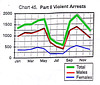
chart45

chart45
chart45,
originally uploaded by malcolmkirkpatrick.
Between 1987 and 1997 most schools in the Hawaii DOE followed a September through June schedule. Juvenile arrests fall when school is not in session. Juvenile hospitalizations for human-induced trauma fall when school is not in session. Reported house burglaries fall when school is not in session (car burglaries rise).

Schools do not prevent crime; they cause it.

2010/08/21

Naturally...

Sex I.D.
Your empathy score is: 5 out of 20
Average score for men: 7.9 out of 20
Average score for women: 10.6 out of 20
On standardized measures of social skills your humble narrator ranks somewhere between clam and desert reptile.

2010/08/18

August 23 Forum Flier

This arrived in the inbox this morning.
................................................................
Candidate Forums on EDUCATION

The recent Furlough Friday crisis has reminded us all that our elected leaders matter! Come and hear what candidates for the offices most directly responsible for Hawaii’s public education system have to say in response to our most pressing questions.

Community organizations focusing on education will be holding a series of three candidate forums at the University of Hawaii at Manoa campus:

• Board of Education At-Large candidates, 6:30 p.m. to 8:30 p.m. Mon. Aug. 23
• Lieutenant Governor candidates, 6:30 p.m. to 8:30 p.m. Mon. Sept. 6, Labor Day
• Governor candidates, 2 p.m. to 4 p.m. Sun. Sept 12

This is the only candidate forum for BOE offices, and is a unique opportunity to learn about and have your questions answered by a panel of 10 confirmed candidates. The public (parents, students, concerned citizens) are invited to submit questions at www.sos808.org.

The moderator will be Neal Milner, former ombuds for UH Manoa, professor of Political Science, and political commentator. The Architecture Building is on University Ave, across from the Atherton YMCA (corner of Metcalf). Street parking is free after 6pm, and a pay lot is availableadjacent to the building. Parking is free on Sundays and Holidays.

All fora are free and open to the public. The events will be broadcast on ‘Olelo. Please check www.sos808.org for updates.

Hosted by Save Our Schools Hawaii, the committee organizing a Hawai’i chapter of Parents for Public Schools, and the American Studies Graduate Students Association of UH.

Contact:
Marguerite Higa
sos.higa@gmail.com

Corey Rosenlee
coreyrosenlee@gmail.com

April Bautista
akbbautista@gmail.com

Save Our Schools Hawaii
www.sos808.org

S.O.S. Hawaii stands with Hawaii's public and charter school children and teachers. We are united behind one promise: we will do all we can to make sure Hawaii's keiki and teachers are valued, prioritized, and that education is sustainably funded. We believe that investing in education today supports all of Hawai'i for tomorrow.
--
April Kamilah B. Bautista

2010/08/17

Think On This

Just go to Sunshine's blog (sidebar) and browse "Iraqi Blogs I like". Notice something? Comfortable Americans, think on this. For some people, daily life is heroic when compared to the average American life.

2010/08/07

Two Proofs by Contradiction

After the fall of the Soviet State the British poet and historian of that State, Robert Conquest, wrote that the West had, as yet, incompletely learned two important lessons: the limits to the amount of good that organized violence (the State) can accomplish, and the stultifying effects of bureaucracy, public and private. The force of law is a blunt instrument. The enormous diversity of individual students' interests and abilities and the enormous diversity of their future career paths make the education industry an unlikely candidate for government control. Yet in the US, State Constitutions, State statutes, and policies in many school districts restrict parents' options for the use of the taxpayers' education subsidy to schools operated by State (government, generally) employees. The term "the public school system" designates those provisions in State Constitutions, those State statutes, and those district policies. Arguments in defense of these restrictions policies fail, as two proofs by contradiction indicate.

I.
The State (government, generally) cannot support education without a definition of "education". Curriculum standards define education. If the "public school system" is not an employment program for dues-paying members of the NEA/AFT/AFSCME cartel, a source of padded construction and supply contracts for politically-connected insiders, and a venue for State-worshipful indoctrination, why cannot any student take, at any time and at any age, an exit exam (the GED will do) and apply the taxpayers' education subsidy toward post-secondary tuition or toward a wage subsidy at any qualified private-sector employer? If it is fraud for a mechanic to charge for the repair of a functional motor and if it is fraud for a physician to charge for the treatment of a healthy patient, then it is fraud for a teacher, school, school district,or State to charge for the instruction of a student who does not need help.

II.
According to the Common Core mission statement:
The standards are designed to be robust and relevant to the real world, reflecting the knowledge and skills that our young people need for success in college and careers. With American students fully prepared for the future, our communities will be best positioned to compete successfully in the global economy.
If "education", as defined by curriculum standards, is really so important, why do these people oppose restrictions on immigration? Do they imagine that immigrant Central Americans enter the US fully informed of the US History standards and the English Language Arts standards?

Either immigration is a threat or education, as the NEA, the AFT, and the Common Core define it, is not necessary. Or both.

2010/08/06

Education Under Obama

Joanne linked this...
"It could have been worse." How?

I can see November from my house.

2010/08/04

Hawaii Reporter Questionnaire

By now, readers can predict my answers to most questions which reporters pose in candidate surveys. The only real point of interest is the questions themselves.

A Hawaii Reporter reporter sent the below.

1.Curriculum and Student Achievement: ...Do you favor the implementation of a sequential, quality, K-12 curriculum that would tie to the state’s standards and that would allow graduates to be college-ready?

No. Children are not standard. The "standard" with the best chance of improving system performance is the parent standard: "Do I want my child in that school?" I support open enrollment across school complex areas, credit by exam for all courses required for graduation, and access to an exit exam (the GED will do) which students may take at any age, at any time.

2. Teacher and Principal Compensation: The American Federation of Teachers finds that Hawaii’s teacher starting compensation package equals $52,150, with an average of $72,682, with principals’ average compensation package at $147,000. Should teacher and principal salaries be based on seniority or performance and outcomes? Should principal performance contracts, as required under Act 51, passed in 2004, be required?

Undecided. I do not see how anyone would assess the performance of an Art teacher, for example. "What works?" is an empirical question which only an experiment can answer. In the realm of public policy, this means numerous local policy regimes or a competitive market in goods and services. A State-monopoly provider is like an experiment with one treatment and no controls: a retarded experimental design.

3. Per pupil expenditures: Hawai‘i was 13th highest among the 50 states in per-student expenditures in 2006-07: $11,060 versus a national average of $9,666. Last year, when all spending is included, Hawaii had a per-student annual spending of about $16,000. Should the Weighted Student Formula funding be increased from .49 on each dollar to ensure that more of the budget gets to schools and classrooms? Why are why not?

The location of an expense is an ambiguous concept. State-level negotiations between the Board, the Department of Budget and Finance and the HSTA produce the teacher contract. Is a teacher's paycheck a school-level expense? If the Board demands that Moanalua Intermediate hire some politician's nitwit cousin on a $50,000 do-nothing consulting contract, is this a school level expense? If the Accounting Branch puts a downtown furniture purchase on Nanakuli's budget, is this a school-level expense?

4. Staffing Formulas: Act 51 implemented a weighted student formula and requires principals spend 70 percent of the DOE operating budget, excluding debt service and capital expenditures. However, the BOE still negotiates labor agreements that include employee ratio formulas, preventing principals from making autonomous hiring decisions. Do you favor eliminating employee ratio formulas in union contracts to allow principals to make hiring decisions? Why or why not?

I favor creation of independent complex-level districts and negotiation of contracts at the complex level. Abolish the Teacher Standards Board. Principals should have the power to build their team.

5. Reliable and Transparent Data: The State Auditor found that the DOE is unable to allocate costs properly and the DOE admits their information system needs replaced in order to provide the public, Legislature and department managers with data that will allow them to make timely decisions. What improvements would you make to get the following information to the public: (1) how much money is expended each year within the entire education system, (2) how much of that money is spent in the classroom, (3) how many people work for the DOE and what positions do they hold, and (4) how many of those employees are classroom teachers who report to a principal?

When a Republican became Governor, the Legislature (D) passed Act 51, which removed DOE finances from outside supervision. Repeal Act 51. Abolish the Board of Education. Remove from the Department of Education all authority over school operations. Transfer to County councils the authority to create school districts at the County level or below. Fund school districts on a per-pupil basis from the General Fund, with funds passing through a (very small) State-level Department of Education.

Real classroom teachers can be counted through student schedules. I have done this for one school. The computer which prints report cards could do this for the entire DOE.

6. Fiscal Autonomy : Should the Legislature would be required to provide lump-sum budgets to the DOE/BOE and the Governor could restrict spending, if at all, only on a lump-sum basis, to allow the DOE fiscal autonomy similar to the University of Hawai‘i?

Yes.

Likewise, should the BOE limit the use of categorical funding and instead provide lump-sum funding to schools or communities that may then choose to purchase centralized DOE or private services?

Yes.

7. Procurement: In 2009, the State Auditor issued a report on the DOE’s procurement practices involving $840 million in facilities money and revealed potentially fraudulent or unethical behavior and a lack of controls and indifference towards procurement compliance. Do you favor implementing internal controls in this department, with corrective or disciplinary procedures for procurement violations?

Yes.

Would you begin by investigating why many schools do not have soap, paper towels and adequate toilet paper? Why or why not?

There are bigger issues. We know from the Federal investigation into the Hawaii Department of Transportation Airports Division how insiders rigged the competitive bid process. Ten years ago, the DOE spent over $200,000 per room to build classroom buildings. This looks excessive for a row of 30'x40'x10' concrete boxes eight units long and three tiers high.

8. Decentralization or Community-Centered Schools: Given that communities in all other states have local control over their schools, do you favor a community-centered school system with control over 90 percent of their community k-12 school budget? Would you favor the BOE limiting itself to developing academic standards and holding accountable community-level school governance?

Abundant evidence supports local control of school. A State-level serves no purpose. Students, parents, real classroom teachers, and taxpayers would benefit if the State-level Department of Education had responsibility for funding and financial oversight only.

9. Charter School Cap: Should the cap on the number of charter schools be lifted with student funding that is equal to other public schools, including money for facilities?

Yes. Further, any 501(c)3 organization should have authority to establish a charter school, and the law should provide for representation elections at individual charter schools.

10. Pension Reform: Last year, $417 million of the DOE’s budget was consumed by pension or employee burden costs. Would you implement any pension reforms that would lessen these costs? If so, what would they be?

The answer is on the dollar bill: "This note is legal tender for all debts public and private". Pay teachers in cash and let them allot their pay to food, rent, health care, and retirement plans as they see fit.

2010/08/03

Inquiring Minds

Since they ask (the Star-Advertiser survey):...

Occupation and employer: Math tutor. Self-employed.
Job history past 10 years: Math tutor, self-employed.
Ever run for public office? When? Outcome?:
1998, 2000, 2002, 2004, 2006, 2008. 0/6.
Other civic experience or community service: US Navy. Community workday volunteer.
Anything else you'd like voters to know about you?: DOE teacher (high school Math), 1982-1995. Blog: The Harriet Tubman Agenda.

Q: 1) What qualifies you to be a member of the Board of Education?
1. I'm a citizen of Hawaii, over 18 and a non-felon. That is all that the law requires.
2. No one is qualified to take education decisions away from parents. This job should not exist. My qualification is that I understand this.

Q: 2) What do schools need to do to better prepare students for careers and college in the 21st century?
Schools need to operate in a competitive environment in which schools offer a variety of courses and methods of instruction. The one-size-fits-all State-monopoly school system guarantees, for most students, a poor match between the individual student's interests and abilities, on the one hand, and the school's curriculum and method of instruction, on the other.

Q: 3) Do you agree the Department of Education should undergo an independent audit of its financials and operations?
Yes. It does not take 12 years at $12,000 per pupil-year to teach a normal child to read and compute. Outside the US, other countries get better results for less than 1/2 what Hawaii's taxpayers spend, per pupil. In 1996, the Singapore TIMSS 8th grade Math 5th (fifth) percentile score was higher than the US 50th (fiftieth) percentile score.

Q: 4) How would you propose the department go about turning around low-performing schools?
1.Abolish the Teacher Standards Board. Allow principals to determine teacher credential requirements.
2. Offer credit by exam for all courses.
3. Mandate that schools must hire parents, on personal service contracts, to provide for their children's education, if the parents apply for the contract. Make payment contingent on performance on commercially available standardized tests.

Q: 5) Many are calling for more accountability at the school level for student achievement. How would you go about making that accountability a reality?
Internal accountability mechanisms inevitably fail. The most effective accountability system that humans have yet devised is a policy which gives to unhappy customers the power to take their business elsewhere. Subsidize parent control of education. Homeschooling, vouchers, tuition tax credits, charter schools.

Q: 6) What solutions should the board be considering as it attempts to improve student achievement during tough fiscal times?
Credit by exam for all courses required for graduation. Offer the GED at any age and subsidize early college admission or private-sector employment at 1/2 the DOE per pupil budget. Subsidize homeschooling at 1/2 the DOE per pupil budget. Abolish the Teacher Standards Board.

Q: 7) Some have argued that the Department of Education spends too much money at the central level and not enough at the school level. Do you agree? Why or why not?
Yes and no. If the Legislature, the Board, or the HSTA contract mandates a school-level expense, is this money spent "at the school level"? If the Board mandates that a school hire some politician's cousin on a $50,000 do-nothing consulting contract, is this a "school-level" expense? If the Accounting branch puts downtown furniture on Nanakuli's budget, is this a school-level expense?

Q: 8) How many children do you have, and do they attend public or private school?
I have no children. I would homeschool if I did. In Hawaii, juvenile arrests fall when school is not in session. Juvenile hospitalizations for human-induced trauma fall when school is not in session.

Olelo Presentation

The public-access cable station Olelo invites candidates for office to tape a brief campaign pitch. Here's mine.
........................................
I'm Malcolm Kirkpatrick, and I want your vote, for Board of Education.

The Hawaii Department of Education operates the ninth largest school district in the US. Standardized test scores put Hawaii in the national cellar. Of course, standardized tests are not the only measure of school performance. In Hawaii, juvenile arrests fall when school is NOT in session. Juvenile hospitalizations for human-induced trauma fall when school is NOT in session. Schools do not prevent crime; they cause it.

Taxpayers supply the Hawaii DOE with over 2 billion dollars every year, over ten thousand dollars per pupil. More than 20,000 people work for the Hawaii DOE. How is it that so many people, with such vast resources, accomplish so little? I think I know.

Numerous lines of evidence support the following generalizations:

First: As institutions take from individual parents the power to determine for their own children the choice of curriculum and the pace and method of instruction, overall system peformance falls.

Second: Political control of school harms most the children of the least politically adept parents.

Mohandas Gandhi opposed compulsory attendance at school. Albert Einstein opposed compulsory attendance at school.

Thomas Edison was homeschooled and started work at 13. Hyram Maxim left school and apprenticed at 14. David Farragut joined the US Navy at 9, went to sea at 11, and commanded his first ship at 15.

It does not take 12 years at $10,000 per pupil-year to teach a normal child to read and compute. Most vocational training occurs more effectively on the job than in a classroom. Government provision of History and Civics instruction is a threat to democracy, just as government operation of newspapers would be and is, in totalitarian countries like North Korea and Cuba.

What we in the US call "the public school system" originated in religious intolerance and anti-Catholic bigotry. In Hawaii, Congregational missionaries established schools to convert the pagans, and the plantation aristocracy used school taxes to drive native Hawaiians out of the subsistence economy and into the cash economy.

The Hawaii "public" school system has become an employment program for dues-paying members of the HSTA, the HGEA, and the UPW, a source of padded construction and supply contracts for politically-connected insiders, and a venue for State-worshipful indoctrination. If this is not so, why cannot any student take, at any age, an exit exam (the GED will do) and apply the taxpayers' $10,000 per year education subsidy toward post-secondary tuition or toward a wage subsidy at any private-sector employer?

In 1993, when Ben Cayetano was Lieutenant Governor, he said "We cannot afford to waste another generation of school kids". Since then, we have wasted another generation of school kids.

Will the current crop of politicians fix this wastful system? No, there's too much money in it. To fix this system voters must elect, to the Legislature and the Board of Education, majorities who favor vouchers, tuition tax credits, or other forms of parent control. They must also elect Governors who favor parent control until a majority of the appointed Hawaii Supreme Court justices favor parent control. In the most optimistic scenario, this is more than 12 years away.

If you have children, you cannot afford to wait. For your children's sake, please homeschool. As Gandhi observed, parents are the natural teachers of children. Nothing in Hawaii law requires that homeschooling instruction occur between 8 in the morning and 2 in the afternoon. It is legal to extend daycare to age 18 and homeschool in the evening.

My name is Malcolm Kirkpatrick. I support school vouchers, charter schools, tuition tax credits, homeschooling, and other forms of parent control. Please give me your support. Thank you for you attention.