...The market is writing down the value of the world economy. Right across the board. It is making a judgement on what they think the future is worth. By recent numbers, not much. Not just because policymakers have gotten it wrong about the “root cause” of terrorism, or the Euro; but also about “Too Big To Fail”, population policy, multiculturalism, a crippling environmentalism and Global Warming, to name a few. The financial, national security and educational systems of the world are in utter collapse because they are stuffed with lies, which even when they are shown to be obviously false suck up trillions of dollars in their pursuit . And nothing will turn the global elites from continuing their ruinous path until they have spent the last nickle and dime they can lay their hands on. Certainly not the media. As Osborne and Weaver wrote:Neither can the mainstream US media be trusted. The relentlessly State-worshipful reporters and editorialists who write for local and national newspapers and broadcast media have not, by and large, accepted responsibility for the one-sided criticism of the Bush presidency and the sanctification of the Obama candidacy, which shifted control of Congress in 2007 and the White House in 2009. This is not a purely partisan point. If Guantanamo detention, warrantless wiretapping, and budget deficits mattered under President Bush, why do they not not matter under President Obama? If climate science mattered enough to appear in the Vice Presidential debate between Sarah Palin and Joe Biden in 2008, why does it not matter now? Why did it never matter enough to merit a thorough public discussion with all relevant areas of expertise represented? When journalists and politicians use issues as partisan weapons, news consumers discount news. Public attention is a scarce resource which reporters and politicians squander with their partisan cheerleading.One urgent lesson concerns the BBC. The corporation’s twisted coverage of the European Union is a serious problem, because the economic collapse of the eurozone means that a new treaty may be needed very soon — plunging the EU right back into the heart of our national politics.Neither the BBC nor any of the similar organizations which have jointly created our fantasy world will return to honesty. Not until it annihilates itself into bankruptcy along with all the other causes it touted and supported. The bad news is that by then most of us will have sunk beneath the waves.
The problem is that the BBC’s record is dreadful. It simply cannot be trusted not to become part of a partisan propaganda operation.
2011/09/23
Read Fernandez
Richard Fernandez ranges widely, though most often with a security policy emphasis, and expresses deep analysis simply. Anyway, read this. All of it.


2011/08/29
Voters, Journalists, or Politicians?
Voters, journalists, or politicians? Whom to target with policy arguments? What impact can any interested individual have? Someone recently quoted Milton Friedman to the effect that political feedback involves less electing good people to office than creating an incentive structure such that bad people will enact good policy or lose office. Anyway, here.
2011/08/13
You Already Knew This
My Political Views
I am a right moderate social libertarian
Right: 5.71, Libertarian: 2.49
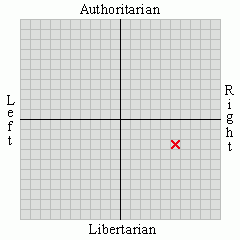
Political Spectrum Quiz
Sunny out. Good weather for climbing avocado trees. Enjoy the day, friends.
Tantalus workday next Saturday.
I am a right moderate social libertarian
Right: 5.71, Libertarian: 2.49
Political Spectrum Quiz
Sunny out. Good weather for climbing avocado trees. Enjoy the day, friends.
Tantalus workday next Saturday.
2011/08/11
"I'll Probably Teach"
This, from the Crack Emcee.
A friend who usually made sense once recommended to me a book by Cornell West. I could not get past the first few pages, for the reason given in the above video clip.
A friend who usually made sense once recommended to me a book by Cornell West. I could not get past the first few pages, for the reason given in the above video clip.
2011/07/31
Happy Birthday, Milton Friedman
Milton Friiedman, 1912-07-31-2006-11-16. The Grassroot Institute held a luncheon in Dr. Friedman's memory on Friday, 2011-07-29. Hawaii Pacific University Economics professor Ken Schooland and former Governor Linda Lingle spoke. Honolulu Star-Advertiser reporter Derrick Depledge, formerly of the Honolulu Advertiser, attended. Depledge once called a "conspiracy theory" Harriet's assertion that DOE officials will lie about the DOE budget if cornered. He did not respond to documentary evidence and the question why he implied that people who hold this view are crazy. At the Grassroot luncheon Harriet suggest to Mr. Depledge that reporters ask to see the DOE Personal Service Contract logs. He said he'd pass the suggestion along to the Education writer, Vicki Viotti.
Wanna bet? Either reporters prefer to avoid conflict with a powerful bureaucracy that grants to friendly reporters easy access to story material or they fear to confront their own beliefs about the healing power of organized violence (the State). Or both.
Wanna bet? Either reporters prefer to avoid conflict with a powerful bureaucracy that grants to friendly reporters easy access to story material or they fear to confront their own beliefs about the healing power of organized violence (the State). Or both.
Save the Cartel!
Via Instapundit, this sequence: Michelle Fields of Reason TV interviews Matt Damon, Deborah Meier (who?), Jonathan Kozol, and some teachers.
Updated (* material added).
*(Fields): "So, you're the founder of the small schools movement, which promoted creativity and choice. Why won't vouchers and charter schools do that?"
*(Meier): "Uh, because the other were part of uh, uh community, democratic operation. This is precisely what differentiates me from libertarians. I've the same ideals but I also know more about the corruption of money."
From personal experience, right? If this response addresses the question "Why don't vouchers promote creativity and choice?", would it not then follow that a voucher-funded school which receives less than the per pupil budget of the cartel's schools be less corrupt and so more likely to promote creativity and choice than the cartel's schools?
*(Fields): "How much more would you like to see going to students?"
*(Teacher 1): "How much money do you think a child is worth? It's unconditional. Children aren't 'worth' money."
*(Fields): "It cost ten thousand dollars, more than ten thousand dollars per student right now."
*(Teacher 1): "I'd pay a million dollars to raise my children. There is no money that can be set, price, on a child's life and learning. This shouldn't be about money; this should be about educating our children in how to survive in today's world."
*(Field): "But if you want the government to spend more, how much more, per student, do you think should go to education?"
*(Teacher 1): "Billions."
*(Fields): "A billion dollars per student?"
*(Teacher 1): "Sure. Why not?"
Because it's mathematically impossible. One billion dollars per student times forty-nine million students is more than three times the US GDP.
**Duh! (49x10^6)x(10^9)=49x10^15, more than three thousand times the 15 trillion US GDP.
(Teacher 2): "Education is a basic social right. Everyone has a right to a public education."
(Fields): "What about food. Isn't food just as important as education?"
(Teacher 2): "Yes. We have...we have various kinds of social safety nets to make sure people can eat. That probably doesn't make some people in this town happy, that we have things like Food Stamps."
Food Stamps are vouchers.
(Fields): "We have choice and competition in preschools and universities, so why not K through 12 education?"
(Teacher 3): "Private schools and universities, if you're talking about private universities, then that is a, that's a money-making operation, right?..."
The NEA/AFT/AFSCME cartel's schools received a tax-generated revenue stream of more than $ 500 billion in 2007-2008, according to the National Center for Education Statistics.
(Teacher 3): "...That is in bed with the capitalist system. If you're talking about public schools; I don't want that to be privatized."
(Fields): "You've written a lot about poverty in the South Bronx. Why aren't vouchers and charter schools an answer to that?"
(Kozol): "Vouchers and charter schools are the worst possible answer. First of all, because they will never serve more than two or three percent, maybe five percent, at most, of the population."
(Fields): "So then we need more charter schools."
(Kozol): "That's insane. The fact is, first of all, charter schools are, on average, are no more successful than public schools?"
Kozol does not address the rebuttal to his point about the fraction of the population served by vouchers. In some countries, it's well over 50% of the population.
Vouchers work.
Gerard Lassibile and Lucia Navarro Gomez
"Organization and Efficiency of Educational Systems: some empirical findings"
Comparative Education, Vol. 36 #1, 2000, Feb.
*Telling, isn't it, that the people whom our elected representatives employ to provide education services make such weak arguments in support of their exclusive position in receipt of the taxpayers' K-12 education subsidy.
Updated (* material added).
*(Fields): "So, you're the founder of the small schools movement, which promoted creativity and choice. Why won't vouchers and charter schools do that?"
*(Meier): "Uh, because the other were part of uh, uh community, democratic operation. This is precisely what differentiates me from libertarians. I've the same ideals but I also know more about the corruption of money."
From personal experience, right? If this response addresses the question "Why don't vouchers promote creativity and choice?", would it not then follow that a voucher-funded school which receives less than the per pupil budget of the cartel's schools be less corrupt and so more likely to promote creativity and choice than the cartel's schools?
*(Fields): "How much more would you like to see going to students?"
*(Teacher 1): "How much money do you think a child is worth? It's unconditional. Children aren't 'worth' money."
*(Fields): "It cost ten thousand dollars, more than ten thousand dollars per student right now."
*(Teacher 1): "I'd pay a million dollars to raise my children. There is no money that can be set, price, on a child's life and learning. This shouldn't be about money; this should be about educating our children in how to survive in today's world."
*(Field): "But if you want the government to spend more, how much more, per student, do you think should go to education?"
*(Teacher 1): "Billions."
*(Fields): "A billion dollars per student?"
*(Teacher 1): "Sure. Why not?"
Because it's mathematically impossible. One billion dollars per student times forty-nine million students is more than three times the US GDP.
**Duh! (49x10^6)x(10^9)=49x10^15, more than three thousand times the 15 trillion US GDP.
(Teacher 2): "Education is a basic social right. Everyone has a right to a public education."
(Fields): "What about food. Isn't food just as important as education?"
(Teacher 2): "Yes. We have...we have various kinds of social safety nets to make sure people can eat. That probably doesn't make some people in this town happy, that we have things like Food Stamps."
Food Stamps are vouchers.
(Fields): "We have choice and competition in preschools and universities, so why not K through 12 education?"
(Teacher 3): "Private schools and universities, if you're talking about private universities, then that is a, that's a money-making operation, right?..."
The NEA/AFT/AFSCME cartel's schools received a tax-generated revenue stream of more than $ 500 billion in 2007-2008, according to the National Center for Education Statistics.
(Teacher 3): "...That is in bed with the capitalist system. If you're talking about public schools; I don't want that to be privatized."
(Fields): "You've written a lot about poverty in the South Bronx. Why aren't vouchers and charter schools an answer to that?"
(Kozol): "Vouchers and charter schools are the worst possible answer. First of all, because they will never serve more than two or three percent, maybe five percent, at most, of the population."
(Fields): "So then we need more charter schools."
(Kozol): "That's insane. The fact is, first of all, charter schools are, on average, are no more successful than public schools?"
Kozol does not address the rebuttal to his point about the fraction of the population served by vouchers. In some countries, it's well over 50% of the population.
Vouchers work.
Gerard Lassibile and Lucia Navarro Gomez
"Organization and Efficiency of Educational Systems: some empirical findings"
Comparative Education, Vol. 36 #1, 2000, Feb.
Furthermore, the regression results indicate that countries where private education is more widespread perform significantly better than countries where it is more limited. The result showing the private sector to be more efficient is similar to those found in other contexts with individual data (see, for example, Psucharopoulos, 1987; Jiminez, et. al, 1991). This finding should convince countries to reconsider policies that reduce the role of the private sector in the field of education.Inevitably, for each sub-adult and at any level of tax support of sub-adult education, some adult or group of adults decides how to spend the subsidy that applies to that sub-adult, and what curriculum that sub-adult will pursue. The argument between voucher, charter, and tax credit advocates, on the one hand, and defenders of the NEA/AFT/AFSCME cartel's exclusive position in receipt of the taxpayers' pre-college education subsidy, on the other, turns on the issue of which adults decide: parents or government agents.
*Telling, isn't it, that the people whom our elected representatives employ to provide education services make such weak arguments in support of their exclusive position in receipt of the taxpayers' K-12 education subsidy.
2011/07/28
Democrats versus Government School Teachers
Years ago, one of Honolulu's daily papers reported a fatal auto accident in which a driver apparently misread the ground, turned off his headlights, and, in the dark of night, rolled over the cliff on the Hamakua coast of the Big Island. A witness reported seeing the brake lights blink after the car was airborne. I think of this when I contemplate the finances of the City and County of Honolulu, the State of Hawaii, the United States of America, and governments worldwide. Vaclav Smil calls the inevitable slow-motion default the "Great Unraveling".
Via Public Finance, this news.
Off the cuff, and just eyeballing chart VI of this report, it looks like there's a strong negative correlation between unfunded public sector pension and benefit liablilities, on the one hand, and NAEP 8th grade Math scores, on the other. I'll take that as a measure of the relation between public-sector integrity and school system performance. Compare North Dakota (tops in the US on NAEP by some measures, low unfunded benefit exposure) and Hawaii (NAEP scores in the national cellar, high unfunded pension and benefit exposure).
Politicians at all levels have made more promises than they can keep. In democratic polities, they make these promises to influential interest groups such as unionized public sector employees and other contractors to the State, and to other well-organized, politically active constituencies. In bureaucratic one-party States, bureaucrats ascend the hierarchy through strategic alliances with superior patrons and loyal subordinates. Financial opacity allows politicians to make impossible promises without fear of immediate contradiction. Within organizations, opacity in either finances or goals contributes to inefficiency (and fraud), as Canice Prendergast suggests in his A Theory of "Yes-Men", (AER). Mounting inefficiencies reduce future resources, including those which would otherwise fund pension and benefit promises. When you (formally, "one", for the nit-pickers of the English Department) have made more promises than you can keep, you will have to break some of them. As Vaclav Smil observed, this will take decades to unfold.
Sorry to sound so grim. Hawaii politicians have not yet acknowledged the financial situation. We're accelerating toward the cliff edge and they refuse to accept even that brakes have a useful function. Individually, many probably accept that the State cannot long continue on the current path. Collectively, they close their eyes.
Homeschool. Start a garden. Learn First Aid. Buy ammunition.
Via Public Finance, this news.
Off the cuff, and just eyeballing chart VI of this report, it looks like there's a strong negative correlation between unfunded public sector pension and benefit liablilities, on the one hand, and NAEP 8th grade Math scores, on the other. I'll take that as a measure of the relation between public-sector integrity and school system performance. Compare North Dakota (tops in the US on NAEP by some measures, low unfunded benefit exposure) and Hawaii (NAEP scores in the national cellar, high unfunded pension and benefit exposure).
Politicians at all levels have made more promises than they can keep. In democratic polities, they make these promises to influential interest groups such as unionized public sector employees and other contractors to the State, and to other well-organized, politically active constituencies. In bureaucratic one-party States, bureaucrats ascend the hierarchy through strategic alliances with superior patrons and loyal subordinates. Financial opacity allows politicians to make impossible promises without fear of immediate contradiction. Within organizations, opacity in either finances or goals contributes to inefficiency (and fraud), as Canice Prendergast suggests in his A Theory of "Yes-Men", (AER). Mounting inefficiencies reduce future resources, including those which would otherwise fund pension and benefit promises. When you (formally, "one", for the nit-pickers of the English Department) have made more promises than you can keep, you will have to break some of them. As Vaclav Smil observed, this will take decades to unfold.
Sorry to sound so grim. Hawaii politicians have not yet acknowledged the financial situation. We're accelerating toward the cliff edge and they refuse to accept even that brakes have a useful function. Individually, many probably accept that the State cannot long continue on the current path. Collectively, they close their eyes.
Homeschool. Start a garden. Learn First Aid. Buy ammunition.
2011/07/27
2011/07/22
More Questions than Answers
Dr. Goe spoke for an hour, using Power Point or some such product. The audience occupied most of the seats in conference room 309. In the course of her presentation, Dr. Goe raised an issue that, while obvious upon a little reflection, receives little attention in popular discussions of teacher evaluation: the lack of standardized measures of performance in courses other than English and Math (once English instruction moves beyond vocabulary and grammar into Literature, common standardized tests no longer assess usual classroom goals here, either).
At the start of the Q&A, Senator Nishihara asked Dr. Goe about the Atlanta School District cheating scandal. Dr. Goe said that cheating on standardized tests is fairly easy to detect and prevent. A larger point behind Senator Nishihara's question remained unadressed: all of Dr. Goe's assessment options assume good faith by system insiders, which assumption the Atlanta District falsifies. Peer review and assessment by a teacher's Principal open wide the door to abuse of whistleblowers. For this and for a reason that Dr. Goe raised at the start, the rudimentary state of evaluation mechanisms, an official, State-wide committment to a single mechanism creates a large risk.
I had parked in metered parking in the Capital basement, so I left. On the way out, I asked the committee clerk about the audience. The clerk suggested that the HSTA sent them.
Milton Friedman once observed that the best protection a good worker has is a competitive market for his talent.
As ever: "What works?" is an empirical question that only a federal system (numerous local policy regimes) or a competitive market in goods and services can answer. A State-monopoly system is like an experiment with one treatment and no controls, a retarded experimental design.
At the start of the Q&A, Senator Nishihara asked Dr. Goe about the Atlanta School District cheating scandal. Dr. Goe said that cheating on standardized tests is fairly easy to detect and prevent. A larger point behind Senator Nishihara's question remained unadressed: all of Dr. Goe's assessment options assume good faith by system insiders, which assumption the Atlanta District falsifies. Peer review and assessment by a teacher's Principal open wide the door to abuse of whistleblowers. For this and for a reason that Dr. Goe raised at the start, the rudimentary state of evaluation mechanisms, an official, State-wide committment to a single mechanism creates a large risk.
I had parked in metered parking in the Capital basement, so I left. On the way out, I asked the committee clerk about the audience. The clerk suggested that the HSTA sent them.
Milton Friedman once observed that the best protection a good worker has is a competitive market for his talent.
As ever: "What works?" is an empirical question that only a federal system (numerous local policy regimes) or a competitive market in goods and services can answer. A State-monopoly system is like an experiment with one treatment and no controls, a retarded experimental design.
2011/07/21
Hearing Notice, 2011-07-21
What will the witness say at this hearing?
Dr. Laura Goe
Dr. Laura Goe
has served as a visiting scholar to the NEA and advisor on their teacher evaluation work, advises the AFT as a member of their expert panel on teacher evaluation, and serves as a consultant to the AFTs Innovation Grant sites in New York and Rhode Island as they design innovative, comprehensive teacher evaluation systems.This blog addressed the matter here.
2011/05/11
Advice: "Be Grateful For The Chance To Be Lost"
Five Feet of Fury linked "Best Alternative To Grad School" by Penelope Trunk. Excerpt:
...the thing that is pushing me over the edge with graduate school is that people who are thinking straight about schooling are not even considering graduate school. These people are debating if college is a rip off (here's a great discussion in New York magazine with James Altucher, a venture capitalist in NYC) And people are even debating if high school is useless (here's a great blog by Lisa Nielsen who is with the NYC Department of Education). And anyway, I'm losing interest in the debate about grad school because I'm convinced that the future belongs to home schoolers because they are self-learners.A legislator recognized me on a downtown street yesterday. We were headed in the same direction for a ways and she asked what I thought of the last session, and specifically of education-related bills. I answered that I had not expected much from this session, and the session met my expectations. I was disappointed but not surprised that the legislature passed on the opportunity to expand homeschoolers' options. In testimony, HSTA representatives opposed bills that would have allowed homeschoolers to participate in extracurricular activities and most legislators voted as the HSTA instructed. You can measure how much the outlook of the average legislator must change before the legislature will address the State government's financial situation that they raided dedicated funds like the hurricane relief fund to address the budget deficit. A more accommodating attitude toward homeschoolers would reduce demands on the government's overstretched resources.
2011/05/10
Thomas Sowell on "Education"
If education is an investment, then the NEA/AFT/AFSCME cartel's K-PhD school system is Enron. State "investment" in education makes as much sense as "industrial policy", the 50's era fad for State direction of investment in heavy manufacturing. Here's Thomas Sowell on "The Education Mantra".
2011/05/05
No Way To Run A Railroad
GE CEO Jeffrey Immelt (Reuters, 2011-05-05): "Even though I believe in global warming and I believe in the science ... it just took on a connotation that was too elitist; it was too precious and it let opponents think that if you had a green initiative, you didn't care about jobs. I'm a businessman. That's all I care about, is jobs."
Whatever happened to Cornelius ("The public be damned. I am working for my stockholders") Vanderbilt?
A CEO who cares only about jobs runs a charity, not a business. The same goes for politicians who, in the interest of current recipients of tax subsidies (such as State employees), subsidize inefficient providers of public goods (such as government-operated schools) at the expense of taxpayers, recipients of those services (such as students), and current and potential employees of alternative providers (such as private school teachers).
Meanwhile, from the Milton and Rose Friedman Foundation for Educational Choice comes this news:...
Indiana Gov. Mitch Daniels Signs Historic Voucher Bill into Law
Whatever happened to Cornelius ("The public be damned. I am working for my stockholders") Vanderbilt?
A CEO who cares only about jobs runs a charity, not a business. The same goes for politicians who, in the interest of current recipients of tax subsidies (such as State employees), subsidize inefficient providers of public goods (such as government-operated schools) at the expense of taxpayers, recipients of those services (such as students), and current and potential employees of alternative providers (such as private school teachers).
Meanwhile, from the Milton and Rose Friedman Foundation for Educational Choice comes this news:...
Indiana Gov. Mitch Daniels Signs Historic Voucher Bill into Law
Thursday, May 05, 2011
Milton and Rose Friedman’s vision of school choice for all takes one step closer to reality
INDIANAPOLIS, IN — The Foundation for Educational Choice today praised Indiana Gov. Mitch Daniels for signing the nation’s largest voucher program into law. The School Scholarship Act (House Bill 1003) creates a school voucher program that has the broadest eligibility of any voucher program in the nation.
“This is truly a historic day for Indiana’s children,” said Robert Enlow, President and CEO of the Foundation for Educational Choice. “Gov. Daniels’ signature today puts Indiana at the top of the class for educational choice. Moreover, this sends an important message to families across the country: meaningful education reform is possible. We should never give up fighting for access to high-quality educational options for every child, regardless of family income or where they live.”
2011/04/26
School Choice Legislation in Oklahoma
From Milton and Rose Friedmans' Foundation for Educational Choice:...
Oklahoma House Passes School Choice Program with Broad Student Eligibility
Oklahoma House Passes School Choice Program with Broad Student Eligibility
OKLAHOMA CITY, OK — More Oklahoma families will be able to send their children to the schools of their choosing, following today's passage of the Oklahoma Equal Opportunity Education Scholarship Act. The bill will provide partial tax credits to individuals and businesses that donate to nonprofits that distribute private-school scholarships to eligible families.
By a vote of 64-43, the Oklahoma House of Representatives approved the measure, which previously passed the Senate chamber by a vote of 30-14.
"This is another step in the direction of choice for Oklahoma's parents and children," Robert Enlow, president and CEO of the Foundation for Educational Choice, said. "We look forward to seeing school choice continue to flourish in the Sooner State, and we are eager to watch other states follow Oklahoma's lead."
2011/04/21
Indiana Voucher Legislation
From Milton and Rose Friedman's Foundation for Educational Choice:...
Indiana Senate Passes Nation's Largest Voucher Bill
Indiana Senate Passes Nation's Largest Voucher Bill
INDIANAPOLIS, IN — The Indiana Senate today passed legislation that would create the nation's broadest school voucher program, allowing low- and middle-income families to use taxpayer funds to send their children to the private school of their choice.This will merit celebration when the Governor signs it. Arizona's Governor, Jan Brewer, just vetoed a tax-rebate-funded voucher program (wasting litigation that had won a 5-4 decision from the US Supreme Court), so strange things can happen. Still, expect this to become law.
House Bill 1003, which was approved by the Senate in a 28-22 vote, would create a new scholarship program enabling families to send their children to the private school of their choice. Scholarship amounts are determined on a sliding scale based on income, with families receiving up to 90 percent of state support.
The Indiana House of Representatives previously approved a similar version of the bill by a vote of 56-42. The Senate version, which adds a $1,000 tax deduction for families that pay out of pocket for private or homeschool expenses, will now go back to the House. If the House agrees to the changes made in the Senate, the bill will proceed to Governor Daniels, who is expected to sign the bill into law.
"This is exciting news," said Robert Enlow, President and CEO of the Foundation for Educational Choice. "We applaud those legislators who stood tall for kids, and we hope the House will concur as soon as possible so that Indiana families who desperately need educational options do not have to wait any longer."
If enacted, the voucher would be available to far more students than other programs in the country, where vouchers are limited to low-income households, students in failing schools, or special-needs students. Under HB 1003, a family of four earning up to $61,000 per year would be eligible.
Additionally, the $1,000 tax deduction for private and homeschool expenses has universal eligibility. The bill also improves Indiana's scholarship tax credit program by increasing the program cap to $5 million, making $10 million in scholarships available to Hoosier families.
2011/04/12
Let's Change the Name
Governor Dr. Neil Abercrombie has made clear his support for public sector employees. He forgets (or refuses to acknowledge) the accumulation of pension debt. Do you get the impression he's just topping off his own pension, and leaving the mess for others to address when he's gone? As with federal entitlement programs like Medicare and Social Security, State pension obligations are uncertain but large. The Government Accounting Standards Board determines the rules according to which actuaries calculate pension commitments. Let's change the name to Government Accounting Standards Panel.
2011/04/11
Education Bubbles
...(F)or Thiel, the bubble that has taken the place of housing is the higher education bubble. “A true bubble is when something is overvalued and intensely believed,” he says. “Education may be the only thing people still believe in in the United States. To question education is really dangerous. It is the absolute taboo. It’s like telling the world there’s no Santa Claus.”Much of this applies to K-12 schooling as well. State and local governments spent more than $800 billion on their K-PhD schools in the 2007-2008 fiscal year, according to this chart from the NCES.
2011/04/09
Not The Tiger Mom
P. J. O'Rourke reviews Amy Chua, Battle Hymn of the Tiger Mother:
Amy Chua, I’ve got bad news. "A"' students work for "B" students. Or not even. A businessman friend of mine corrected me. "No, P. J.," he said, " ‘B’ students work for ‘C’ students. ‘A’ students teach.”I used to tell my students that it was okay to get an A if they found my course easy. A Math professor friend of mine says he prefers "B" students to "A" students, on average, since the temperment of the "A" students inclines them to unthinking acceptance. I'd like to see a scholarship for students with the widest variance between SAT scores and GPA. The kid with a combined 700 SAT (old style) and a 3.75 GPA would be an interesting kid to have in class. Ditto the kid with the 1560 SAT and the 1.75 GPA. I wonder if they'd get along in freshman Physics.
2011/04/03
2011/04/01
Awww, Shoot
How does one man with a six-shot revolver hold 76 hostages in their seats? He plugs the wheelchair-bound old man across the room between the eyes with one shot, to demonstrate that (a) he can hit his target and (b) he has absolutely no inhibitions regarding killing. If the crowd rises simultaneously, they'll get him, but the first five out of their seats will die.
The tragedy of the commons is a multi-party, iterated prisoner's dilemma, with memory. Why do people pick the mangoes on trees which grow on public land at an earlier stage of development than they pick the mangoes from the trees in their own yards? The commons does nor reward self-restraint in the harvest. The commons does not reward courage against a threat. Stay seated and live, or, at least, hope to be the last to die.
Friday, 2011-04-01 (1-April-2011), the Hawaii Senate Education committee holds hearings on Governor Abercrombie's nomination of J. N. Musto (Executive Director, University of Hawaii Professional Assembly) to the Education Commission of the States and Louise Cayetano (teacher), Wray Jose (teacher), and Barry Wurst (teacher) to the Hawaii Teacher Standards Board. The University of Hawaii Professional Assembly is an NEA subsidiary. Whether or not Dr. Musto's contributions to the Governor's election campaign influenced the Governor's selection, members of the legislature will note the access that the Governor has given to Dr. Musto.
Governor Abercrombie devoted several lines in his inaugural address to the State's budget problems, immediate and long-term. The State-Advertiser recently reported comments by legislators expressing dissatisfaction with the lack of leadership from the Governor on the budget issue. Leadership on budget issues will not come from the legislature. Public sector unions hold legislators hostage; oppose them and the NEA/AFSCME cartel will subsidize a primary challenge and your general election opponent, guaranteed.
Humans have the mass of the Earth, a steady rain of meteoric dust, and a solar budget. They apply ingenuity to these resources. The sun shines, rain falls, and the Earth sustains plants. Variations in the circumstances we call "economic" largely result from variations in human attention. While it may seem natural to nominate insiders to governing boards, the Governor's nominations of insiders to governing boards of the most expensive programs in the State budget communicate to legislators that they will get no leadership on budget issues from him. He may as well have tossed the gunman an extra box of cartridges. Governor Abercrombie won't be leaping from his seat, you can be sure.
The tragedy of the commons is a multi-party, iterated prisoner's dilemma, with memory. Why do people pick the mangoes on trees which grow on public land at an earlier stage of development than they pick the mangoes from the trees in their own yards? The commons does nor reward self-restraint in the harvest. The commons does not reward courage against a threat. Stay seated and live, or, at least, hope to be the last to die.
Friday, 2011-04-01 (1-April-2011), the Hawaii Senate Education committee holds hearings on Governor Abercrombie's nomination of J. N. Musto (Executive Director, University of Hawaii Professional Assembly) to the Education Commission of the States and Louise Cayetano (teacher), Wray Jose (teacher), and Barry Wurst (teacher) to the Hawaii Teacher Standards Board. The University of Hawaii Professional Assembly is an NEA subsidiary. Whether or not Dr. Musto's contributions to the Governor's election campaign influenced the Governor's selection, members of the legislature will note the access that the Governor has given to Dr. Musto.
Governor Abercrombie devoted several lines in his inaugural address to the State's budget problems, immediate and long-term. The State-Advertiser recently reported comments by legislators expressing dissatisfaction with the lack of leadership from the Governor on the budget issue. Leadership on budget issues will not come from the legislature. Public sector unions hold legislators hostage; oppose them and the NEA/AFSCME cartel will subsidize a primary challenge and your general election opponent, guaranteed.
Humans have the mass of the Earth, a steady rain of meteoric dust, and a solar budget. They apply ingenuity to these resources. The sun shines, rain falls, and the Earth sustains plants. Variations in the circumstances we call "economic" largely result from variations in human attention. While it may seem natural to nominate insiders to governing boards, the Governor's nominations of insiders to governing boards of the most expensive programs in the State budget communicate to legislators that they will get no leadership on budget issues from him. He may as well have tossed the gunman an extra box of cartridges. Governor Abercrombie won't be leaping from his seat, you can be sure.
Subscribe to:
Posts (Atom)